
Regeneration in aesthetic medicine is now understood as a highly complex biological process that depends on continuous intercellular communication, where multiple signaling systems interact simultaneously to maintain tissue stability, repair mechanisms, and long-term structural integrity across skin, hair follicles, and connective tissues under both physiological and environmental stress conditions.
Within this evolving scientific framework, Plant derived exosome nanoparticles have emerged as one of the most advanced regenerative components because they participate in supporting cellular communication networks that regulate repair, renewal, and biological balance at a deeper functional level rather than acting as superficial cosmetic agents.
Modern regenerative approaches are therefore shifting from isolated ingredient-based solutions toward integrated biological systems that aim to enhance multiple pathways at once, ensuring more comprehensive support for tissue function, regeneration, and adaptive response mechanisms over time.
In aesthetic medicine, innovation is often associated with breakthrough ingredients, where one year growth factors dominate clinical interest, followed by peptides becoming the primary focus, and more recently exosome technologies gaining significant attention as part of advanced regenerative strategies, with Plant derived exosome nanoparticles representing a key evolution in this field.
Despite the progress made by individual technologies, it is now clear that regeneration cannot be attributed to a single active ingredient because biological systems are inherently interconnected, relying on coordinated pathways that regulate repair, inflammation control, collagen production, pigmentation balance, and follicular activity simultaneously.
These interconnected systems depend on continuous communication between cells, and Plant derived exosome nanoparticles play an essential role in supporting this communication network by contributing to the regulation of biological signaling processes that maintain tissue health and functional stability over time.
UNIVA Regenerative Platform Foundation
The UNIVA regenerative platform is designed based on a multi-layer biological strategy that integrates Plant Derived Exosome Like Nanoparticles (PDENs), Growth Factors, and Biomimetic Peptides into a unified system that supports cellular communication, tissue repair, and regenerative optimization across multiple clinical indications with a structured scientific approach.
This integrated platform is developed to address different aesthetic concerns such as skin rejuvenation, pigmentation disorders, acne management, scar remodeling, and hair restoration by targeting multiple biological pathways simultaneously rather than relying on a single mechanism of action or isolated functional ingredient.
Within this framework, Plant derived exosome nanoparticles act as a foundational communication element that enhances intercellular signaling efficiency and supports the overall biological environment required for effective regenerative outcomes across different treatment protocols.
For clinicians seeking to integrate regenerative aesthetic solutions into their practice, Devoté Aesthetics provides structured scientific support and product guidance for medical use.
Why Cellular Communication Matters
Cellular communication represents the fundamental biological mechanism through which tissues maintain balance, repair damage, and respond to environmental stressors, where billions of cells continuously exchange molecular signals every second to regulate essential processes such as inflammation control, collagen synthesis, and structural tissue maintenance.
Plant derived exosome nanoparticles contribute to this system by supporting the efficiency of intercellular signaling pathways that influence how cells coordinate repair and regeneration activities within complex biological environments such as skin layers, connective tissue structures, and follicular units.
When these communication pathways function efficiently, tissues demonstrate improved resilience, faster recovery, and better adaptation to stress factors, while reduced communication efficiency during aging leads to visible deterioration in skin quality, delayed healing responses, and reduced regenerative capacity.
For dermatologists and aesthetic physicians who want to understand clinical application protocols in more detail, additional scientific resources and support are available through Devoté Aesthetics.
The First Pillar: Plant Derived Exosome Like Nanoparticles
Plant derived exosome nanoparticles represent a new generation of regenerative science focused primarily on enhancing cellular communication mechanisms that allow cells to exchange biological information effectively, ensuring proper coordination of repair, renewal, and maintenance processes at a deeper physiological level.
These nanoparticles are not designed as surface-level cosmetic agents but instead function within the biological communication framework that governs how tissues respond to damage, aging, and environmental stress, making them a foundational component in advanced regenerative platforms.
By supporting these signaling pathways, they contribute to maintaining tissue stability and improving the biological environment required for effective regeneration across multiple clinical applications.
The Second Pillar: Growth Factors
Growth Factors are naturally occurring regulatory proteins that play a critical role in controlling cellular activities related to tissue repair, regeneration, and structural maintenance, including processes such as collagen synthesis, extracellular matrix remodeling, and wound healing responses that are essential for maintaining skin and hair health.
Within advanced regenerative systems, Plant derived exosome nanoparticles work synergistically with Growth Factors to enhance cellular responsiveness and improve the efficiency of biological repair mechanisms by supporting the signaling environment required for optimal tissue function.
As part of the natural aging process, Growth Factor activity gradually declines, which leads to reduced regenerative efficiency, slower healing responses, and diminished structural support in both dermal and follicular tissues over time.
The Third Pillar: Biomimetic Peptides
Biomimetic peptides are specialized bioactive molecules designed to replicate natural signaling sequences found within the body, allowing them to interact with specific cellular receptors and activate targeted biological pathways responsible for maintaining skin structure, elasticity, and regenerative capacity.
These peptides function as precision-based messengers that influence key biological activities such as collagen stimulation, barrier repair, cellular renewal, and follicular activation, depending on their molecular design and intended clinical application within regenerative protocols.
When combined with Plant derived exosome nanoparticles and Growth Factors, biomimetic peptides contribute to a highly coordinated regenerative system that enhances multiple biological processes simultaneously while maintaining functional specificity across different treatment indications.
Why One Technology Is Not Enough
Regenerative medicine cannot rely on a single mechanism of action because biological systems are inherently multi-factorial, involving numerous interconnected pathways that regulate inflammation, oxidative stress, cellular aging, and tissue remodeling processes simultaneously across different layers of the skin and underlying structures.
Plant derived exosome nanoparticles alone cannot address all aspects of biological aging because conditions such as pigmentation disorders, acne, and hair loss each involve distinct physiological mechanisms that require targeted multi-pathway interventions rather than isolated therapeutic approaches.
Therefore, modern regenerative strategies must integrate multiple technologies that work together to support comprehensive biological restoration at both cellular and tissue levels.
Clinical adoption of regenerative technologies requires structured understanding of indications and protocols, which is supported by Devoté Aesthetics for qualified medical professionals.
UNIVA Clinical Application Approach
The UNIVA platform applies a structured clinical methodology in which each formulation is developed based on a specific aesthetic indication while maintaining a unified regenerative foundation that ensures consistency in biological support mechanisms across all product lines and therapeutic applications.
Within this system, Plant derived exosome nanoparticles function as a constant biological support element that enhances cellular communication and ensures that each formulation contributes effectively to tissue regeneration processes according to its intended clinical purpose.
Skin Rejuvenation
Skin rejuvenation depends on multiple biological factors including hydration balance, collagen integrity, elasticity, and cellular turnover rates, all of which naturally decline over time as part of the aging process, resulting in visible changes in skin quality and structure.
Plant derived exosome nanoparticles play a supportive role in enhancing these biological pathways by improving intercellular communication and contributing to the regulation of regenerative processes within the dermal environment.

UNIVA EXO HA
UNIVA EXO HA is formulated using a combination of PDEN technology, Growth Factors, Biomimetic Peptides, Hyaluronic Acid, and Plant derived exosome nanoparticles to support skin regeneration, hydration balance, and overall tissue quality improvement through multi-pathway biological enhancement mechanisms.
Pigmentation Management
Pigmentation disorders are complex conditions influenced by multiple biological factors including inflammation, oxidative stress, and melanocyte activity, where disruption in cellular communication often contributes to uneven skin tone and long-term pigmentation irregularities.
Plant derived exosome nanoparticles support these processes by contributing to the regulation of cellular signaling pathways that influence pigment balance and skin homeostasis across different dermal layers.
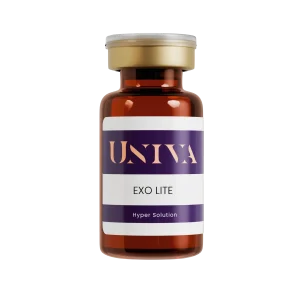
UNIVA EXO LITE
UNIVA EXO LITE works through a targeted formulation approach that integrates regenerative technologies to support pigmentation control, skin clarity, and biological balance within the epidermal environment.
Acne Management
Acne represents a multifactorial inflammatory condition that involves disruption in sebum regulation, bacterial activity, inflammatory response, and tissue repair mechanisms, all of which contribute to the progression and persistence of active lesions.
Plant derived exosome nanoparticles support inflammatory balance and tissue recovery processes that are essential for maintaining healthier skin environments in acne-prone conditions.
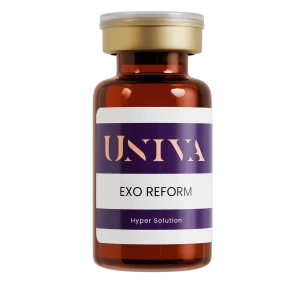
UNIVA EXO REFORM
UNIVA EXO REFORM is designed to support active acne treatment protocols by addressing multiple biological pathways involved in inflammation control and skin recovery processes.
Scar Remodeling
Scar formation occurs as a result of disrupted tissue repair mechanisms where collagen deposition and structural remodeling processes do not follow normal regenerative patterns, leading to visible changes in skin texture and integrity.
Plant derived exosome nanoparticles contribute to the regulation of these healing processes by supporting biological signaling pathways involved in tissue regeneration and post-procedure recovery.
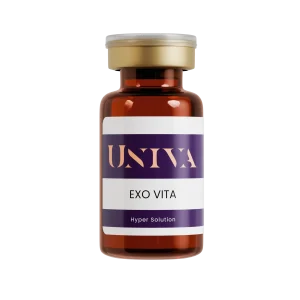
UNIVA EXO VITA
UNIVA EXO VITA is formulated to support tissue repair and scar remodeling processes through regenerative mechanisms that enhance collagen activity and improve overall skin structure following aesthetic procedures.
Hair Restoration
Hair growth and follicular health depend on continuous biological communication between dermal papilla cells, vascular networks, and surrounding tissue structures that regulate hair cycle activity and follicle regeneration processes over time.
Plant derived exosome nanoparticles support these communication pathways by enhancing cellular signaling efficiency within the scalp environment and contributing to improved follicular activity.
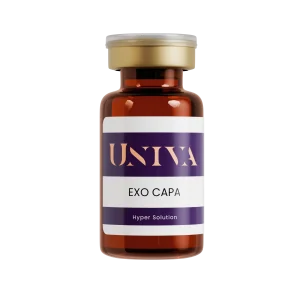
UNIVA EXO CAPA
UNIVA EXO CAPA is designed to support hair restoration protocols by targeting multiple biological mechanisms involved in hair loss, follicle stimulation, and post-transplant recovery processes within the scalp microenvironment.
Why Indication-Specific Design Matters
Effective regenerative medicine requires precise formulation design that takes into account the unique biological mechanisms underlying each aesthetic condition, rather than applying a generalized approach that does not differentiate between distinct physiological processes.
Plant derived exosome nanoparticles are therefore utilized within structured, indication-specific protocols to ensure that each formulation delivers targeted biological support aligned with its intended clinical application.
The Future of Regenerative Medicine
The future of aesthetic medicine is expected to rely increasingly on integrated biological systems that combine multiple regenerative technologies into unified platforms designed to optimize cellular communication, tissue repair, and long-term biological function.
Plant derived exosome nanoparticles will continue to play a central role in this evolution as regenerative science advances toward more sophisticated multi-pathway therapeutic strategies.
Conclusion
Regenerative medicine is transitioning toward a new model based on biological integration rather than isolated treatment mechanisms, where multiple technologies work together to support comprehensive tissue restoration and functional improvement across different aesthetic indications.
Plant derived exosome nanoparticles represent a foundational component of this transformation, contributing to the development of advanced regenerative systems that prioritize cellular communication and multi-pathway biological support.
The future of regeneration will be defined by systems that operate in synergy rather than standalone solutions, ensuring more effective and sustainable outcomes in aesthetic medicine.
For partnership opportunities, training programs, and clinical access to regenerative aesthetic technologies, Devoté Aesthetics offers dedicated support for clinics and medical practitioners.
Plant derived exosome nanoparticles are advanced biological messengers derived from plant-based stem cell technologies that support cellular communication processes involved in tissue repair, regeneration, and biological balance. They are used in modern regenerative aesthetic protocols to enhance skin quality, collagen activity, and overall tissue function.
Plant derived exosome nanoparticles work by improving intercellular communication, which enhances the effectiveness of growth factors and biomimetic peptides. Together, these technologies create a multi-pathway regenerative system that supports collagen synthesis, tissue repair, inflammation control, and skin rejuvenation at a deeper biological level.
Regenerative platforms based on Plant derived exosome nanoparticles are designed to support multiple clinical indications including skin rejuvenation, pigmentation disorders, acne management, scar remodeling, and hair restoration. These applications are typically used in clinical settings under the supervision of dermatologists and aesthetic physicians.